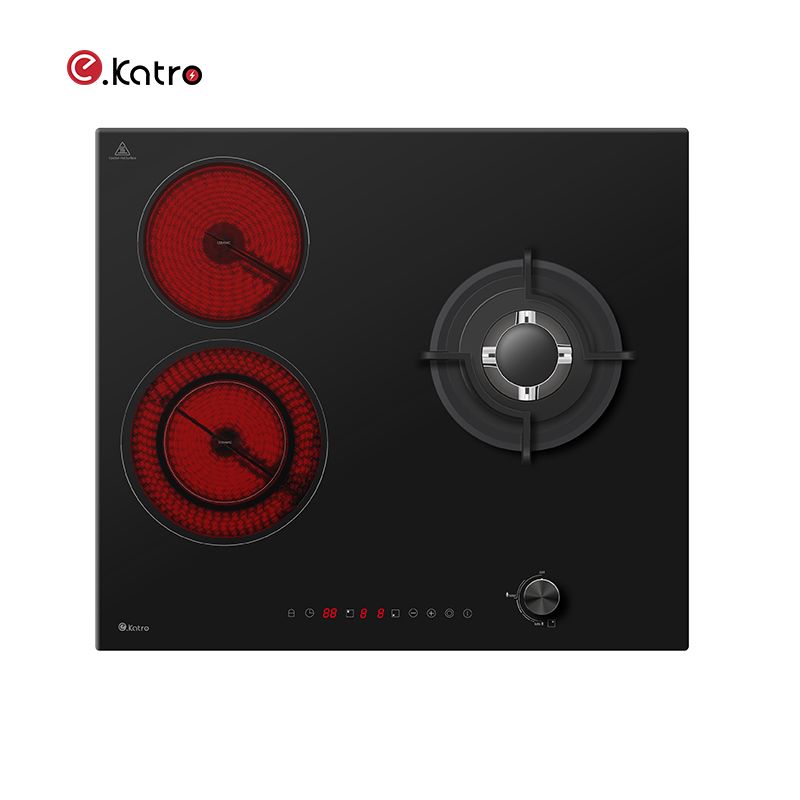
Nowadays, a growing number of home cooking enthusiasts are opting for induction cooktops with ceramic glass panels. Their advantages include rapid heating, precise temperature control, and high thermal efficiency. Unlike gas or electric radiant cooktops, induction cooktops transfer heat energy directly to the base of the cookware rather than dispersing it to the surrounding area, making them more energy-efficient.
Furthermore, the smooth, flat surface of induction cooktops makes cleaning exceptionally easy and enhances safety. Because the heating coil transfers energy directly to the pot, the cooktop surface doesn't become excessively hot, effectively reducing the risk of burns. The ceramic glass material is not only aesthetically pleasing but also boasts excellent scratch resistance, impact resistance, and tolerance to temperature changes, resisting cracking or warping even under high heat or physical stress.
The prerequisite for using cookware on an induction cooktop is that it must be magnetic, typically requiring ferrous materials like iron or certain types of stainless steel. The principle of induction heating relies on magnetic fields activating the iron particles within the cookware, so the base must contain sufficient iron content.
A simple test is to check if a magnet sticks firmly to the pot's base. It's important to note that some stainless steel pots might be slightly magnetic but still not compatible with induction cooking if their nickel content is too high.
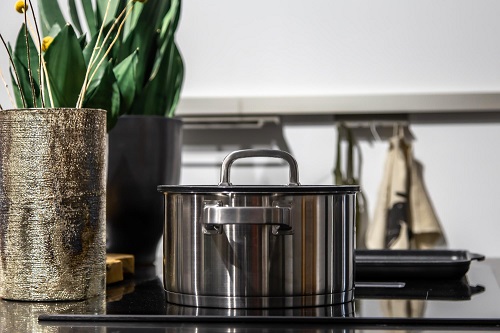
1. When shopping online, use keywords like ""induction compatible"" or ""suitable for induction cooktops"";
2. A flat base is crucial, as uneven bases can cause noise and lead to uneven heating;
3. Lids with some weight are preferable, as they are less likely to vibrate or shift from steam pressure during cooking;
4. The cookware size should match the cooktop's heating zone; a base that's too small reduces heating efficiency;
5. Also, carefully check the handles for comfort, heat resistance, and secure attachment.
Purely glass, aluminum, or copper cookware generally will not work on induction cooktops unless their base has been specially magnetized. Consumers should pay close attention to product descriptions stating ""induction compatible.""
1. Stainless Steel Pots
High-quality stainless steel pots often feature an aluminum or copper core layered between the inner and outer steel walls to improve heat conduction and uniformity. Look for triple-ply or five-ply clad constructions to minimize noise from material vibration and ensure more even heat distribution.
2. Non-Stick Pots with Magnetized Bases
This type of cookware typically has an aluminum body with a magnetized base suitable for the rapid heating of induction cooktops. When selecting, check that the coating is free from harmful substances like PFOA, lead, and cadmium.
3. Cast Iron / Enameled Cast Iron Pots
Due to its high iron content, cast iron is highly compatible with induction cooktops. Enameled cast iron provides a non-stick surface while retaining good heating properties and offers long durability, although it tends to be heavy and heats up and cools down relatively slowly.
4. Carbon Steel Pots
As a lighter alternative to cast iron, carbon steel pots heat up faster and respond more quickly to temperature changes, making them ideal for induction cooking that requires flexible heat adjustment.