In the modern kitchen, the evenness of heat distribution from an appliance is crucial to cooking success – whether it's the ""wok hei"" of stir-frying or the rich depth of slow stewing, all depend on precise heat control. Induction cooktops and ceramic cooktops, as two mainstream electric cooking appliances, have distinct characteristics in heat distribution due to their different heating principles, making them a focal point for consumer choice. The product line of home appliance supplier Katro Appliances includes both induction and ceramic cooktop series, and it can provide customized cooking programs based on client and market needs, empowering personalized kitchen experiences with technology.
Induction cooktops use magnetic induction to generate eddy currents for heating. An electric current creates an alternating magnetic field, causing the base of ferrous cookware to generate heat itself. Their advantages include high thermal efficiency and rapid heating, typically with an efficiency of 80%-90%. The heat is concentrated at the pot's bottom, making them suitable for cooking methods requiring fast, high temperatures, such as Chinese stir-frying or boiling water. However, the uniformity of heat distribution on an induction cooktop highly depends on the flatness and magnetic permeability of the cookware. If the pot is warped or made of unsuitable material, localized overheating or uneven heating can occur, affecting the dish's outcome.
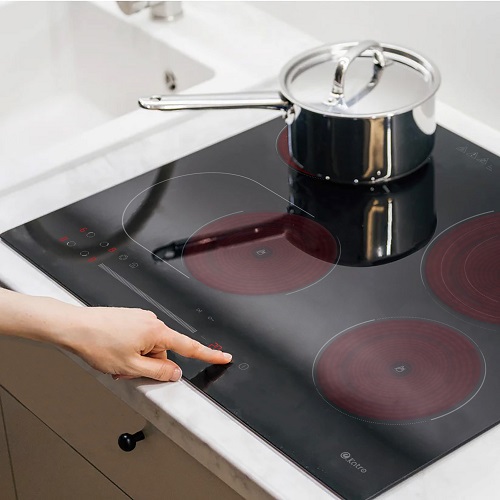
Ceramic cooktops, on the other hand, use heating elements located beneath a smooth ceramic glass surface to generate heat, which is then transferred through the surface to the cookware. Their heating method is closer to a traditional flame, providing relatively gentler heating. Heat distribution is generally more even, making them particularly suitable for simmering, frying, low-temperature sous-vide, and other cooking styles demanding stable heat. Since they are not limited to specific cookware (unlike induction cooktops which require magnetic cookware), ceramic cooktops have broader compatibility – various pots and pans made from ceramic, glass, stainless steel, etc., can be used. However, ceramic cooktops have relatively lower thermal efficiency, around 60%-70%, and retain residual heat for a longer time, requiring caution against burns.
Faced with these two product types, each with its own strengths, market demand is diverse. Urban young families seeking efficiency and speed might prefer the instant-on, instant-heat capability of induction cooktops. In contrast, users who value the cooking process and appreciate a slower, quality-focused lifestyle might favor the even and gentle heat of ceramic cooktops. Furthermore, regional dietary habits influence choice – areas with a strong stir-fry tradition might lean towards induction, while markets with a preference for stewing and soup-based cuisines might view ceramic cooktops more favorably.
Recognizing this market segmentation, Katro Appliances has not simply chosen one over the other but adopted a dual-line product strategy, providing targeted solutions for different customer segments. Katro's induction cooktop series emphasizes high power and intelligent temperature control, meeting the demand for precise heat in fast-paced lives. The ceramic cooktop series focuses on even heating and broad compatibility, suitable for various cooking scenarios.
More importantly, Katro Appliances announced that it can develop specialized cooking programs for both types of products based on client or specific market needs. For instance, for induction cooktops, programmable ""Intelligent Stir-fry"" modes can be developed to optimize power output curves and prevent instant overheating. For ceramic cooktops, ""Low-Temperature Sous-Vide"" or ""Constant Temperature Frying"" programs can be set, precisely controlling temperature and time. This custom service, combining hardware and software, allows both professional chefs and cooking enthusiasts to find the perfect heat assistant for their needs, elevating heat distribution control to a new level of intelligence and personalization.
The competition in heat distribution between induction and ceramic cooktops essentially reflects the clash of different cooking philosophies and lifestyles. By offering both technological paths supplemented by customizable cooking programs, Katro Appliances demonstrates not only its profound technical expertise but also its market philosophy of being ""customer-centric."" In the increasingly competitive kitchen appliance market, this flexibility and foresight will undoubtedly help Katro"


